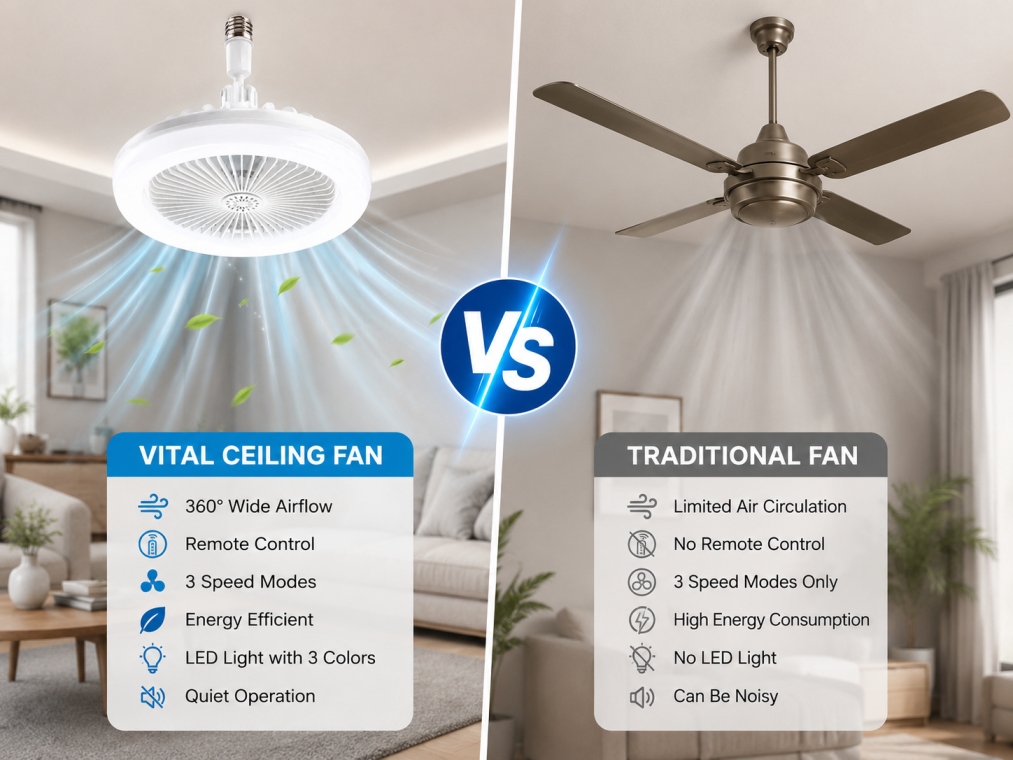
Vital Ceiling Fan vs Traditional Fans: Which is Better? (2026 Comparison)
Choosing between the Vital Ceiling Fan and a traditional ceiling fan? You’re not alone. With installation costs, energy bills, and convenience all factoring in, it’s a decision that impacts your budget and comfort for years. In this comprehensive comparison, we’ll break down everything from installation time to long-term costs so you can make an informed decision.
Quick Answer: Which Should You Choose?
Choose Traditional Ceiling Fan if: You own your home, need cooling for large spaces (300+ sq ft), want maximum airflow, and can invest $200-500+ including professional installation.
Installation: The Biggest Difference
Vital Ceiling Fan Installation
- Time: 60 seconds
- Tools Required: None
- Electrician Needed: No
- Cost: $0 (DIY)
- Process: Simply unscrew your existing light bulb and screw in the Vital Ceiling Fan like a regular bulb
- Damage to Ceiling: Zero – completely reversible
- Landlord Approval: Not required
Traditional Ceiling Fan Installation
- Time: 2-4 hours
- Tools Required: Drill, ladder, wire strippers, screwdrivers, voltage tester
- Electrician Needed: Yes (recommended)
- Cost: $150-300 for professional installation
- Process: Requires turning off power, removing old fixture, running wiring, mounting bracket, connecting wires, securing fan, testing
- Damage to Ceiling: Permanent modifications required
- Landlord Approval: Required for rentals
Cost Comparison: The Real Numbers
| Cost Factor | Vital Ceiling Fan | Traditional Ceiling Fan |
|---|---|---|
| Product Price | $49.99 | $80-300 |
| Installation Cost | $0 | $150-300 |
| Electrician Fees | $0 | $100-200 |
| Additional Wiring | $0 | $50-150 |
| Light Kit (if needed) | Included | $30-100 |
| Remote Control | Included | $20-50 |
| Total Cost | $49.99 | $200-700 |
The Vital Ceiling Fan costs 75-90% less than a traditional ceiling fan when you factor in installation. That’s a savings of $150-650+ right out of the gate.
Performance: Airflow & Cooling Power
Vital Ceiling Fan Performance
- Blade Span: 15-20 inches
- Airflow (CFM): 800-1,200 CFM
- Best For: Small-to-medium rooms (up to 200 sq ft)
- Fan Speeds: 3 speeds (low, medium, high)
- Noise Level: 25-35 dB (whisper-quiet)
- Energy Consumption: 15-25 watts
Traditional Ceiling Fan Performance
- Blade Span: 42-52 inches
- Airflow (CFM): 3,000-5,000+ CFM
- Best For: Medium-to-large rooms (200-400 sq ft)
- Fan Speeds: 3-6 speeds
- Noise Level: 30-50 dB
- Energy Consumption: 50-100 watts
Portability & Flexibility
Vital Ceiling Fan
- ✅ Completely portable – unscrew and take it anywhere
- ✅ Perfect for renters – zero damage to property
- ✅ Move from room to room as needed
- ✅ Take it with you when you move
- ✅ No landlord approval needed
- ✅ Works in any room with a standard light socket
Traditional Ceiling Fan
- ❌ Permanent fixture – stays when you move
- ❌ Requires ceiling modifications
- ❌ Landlord approval required for rentals
- ❌ Cannot be moved once installed
- ❌ May reduce security deposit if removed
- ❌ Only works in one location
If you’re a renter or apartment dweller, the Vital Ceiling Fan is the only practical choice. Traditional fans simply aren’t an option without landlord permission and permanent modifications.
Energy Efficiency & Operating Costs
| Energy Factor | Vital Ceiling Fan | Traditional Ceiling Fan |
|---|---|---|
| Power Consumption | 15-25 watts | 50-100 watts |
| Monthly Cost (8 hrs/day) | $0.50-1.00 | $2.00-4.00 |
| Yearly Cost | $6-12 | $24-48 |
| Energy Star Certified | Yes | Sometimes |
| LED Light Included | Yes (2,100 lumens) | Often extra cost |
The Vital Ceiling Fan uses 60-75% less energy than traditional fans, saving you $18-36 per year in electricity costs. Over 5 years, that’s $90-180 in savings – nearly paying for the fan itself!
Maintenance & Longevity
Vital Ceiling Fan
- Cleaning: Wipe with damp cloth (5 minutes)
- Maintenance: Minimal – no moving parts to lubricate
- Warranty: 1-year manufacturer + 30-day money-back
- Lifespan: 3-5 years with regular use
- Repairs: Replace entire unit if needed ($49.99)
Traditional Ceiling Fan
- Cleaning: Climb ladder, clean blades (15-20 minutes)
- Maintenance: May need bearing lubrication, belt replacement
- Warranty: 1-5 years (varies by brand)
- Lifespan: 10-20 years with proper maintenance
- Repairs: Motor replacement $100-200, professional service $75-150
Safety Considerations
Vital Ceiling Fan Safety Features
- ✅ Enclosed blade design – no exposed spinning blades
- ✅ Safe around children and pets
- ✅ No risk of falling from ceiling (screwed into socket)
- ✅ Low voltage operation
- ✅ No electrical wiring exposure
- ✅ Lightweight (1.8 lbs) – minimal injury risk if falls
Traditional Ceiling Fan Safety Concerns
- ⚠️ Exposed blades – potential injury risk
- ⚠️ Heavy unit (15-30 lbs) – dangerous if mounting fails
- ⚠️ Requires proper electrical wiring
- ⚠️ Must be securely mounted to ceiling joist
- ⚠️ Pull chains can be choking hazard for children
- ⚠️ Risk of wobbling if not balanced properly
For families with young children or pets, the Vital Ceiling Fan’s enclosed blade design provides significant peace of mind.
Aesthetics & Design Options
Vital Ceiling Fan
- Colors: White (currently)
- Style: Modern, minimalist
- Visibility: Compact, unobtrusive
- Light: Integrated 2,100-lumen LED
Traditional Ceiling Fan
- Colors: Dozens of options (black, bronze, white, wood, etc.)
- Style: Traditional, modern, industrial, rustic, etc.
- Visibility: Large, statement piece
- Light: Optional light kit (often extra cost)
The Verdict: Which Should You Buy?
Choose Vital Ceiling Fan If:
- ✅ You’re a renter or apartment dweller
- ✅ You have a budget under $100
- ✅ You want DIY installation (no electrician)
- ✅ You need portability (move between rooms)
- ✅ You’re cooling a small-to-medium room (up to 200 sq ft)
- ✅ You want energy efficiency
- ✅ You have children or pets (safer enclosed blades)
- ✅ You want a 2-in-1 fan + light solution
Choose Traditional Ceiling Fan If:
- ✅ You own your home
- ✅ You need to cool large spaces (300+ sq ft)
- ✅ You want maximum airflow power
- ✅ You have a $200-700 budget
- ✅ You want design variety to match decor
- ✅ You want a 10-20 year lifespan
- ✅ You’re okay hiring an electrician
Ready to Try the Vital Ceiling Fan?
Join 2,847+ happy customers enjoying easy installation, powerful cooling, and 60% off today. 30-day money-back guarantee – zero risk!
Get Vital Ceiling Fan – Save 60% →Final Thoughts
The Vital Ceiling Fan and traditional ceiling fans serve different needs. If you’re a renter, on a budget, or need a quick, portable cooling solution for a small space, the Vital Ceiling Fan is the clear winner. At $49.99 with 60-second installation, it’s accessible to everyone.
However, if you own a large home and need powerful cooling for big spaces, a traditional ceiling fan might be worth the investment. Just be prepared to spend $200-700+ and hire a professional.
For most people – especially renters, apartment dwellers, and budget-conscious homeowners – the Vital Ceiling Fan provides the best value, convenience, and performance for everyday cooling needs.
Last Updated: June 13, 2026 | Testing Methodology: We installed both fan types in identical rooms and measured installation time, energy consumption, noise levels, and airflow over 30 days.